AI agent identity: what the IETF AIMS draft proposes
Published on 15 September 2026, the IETF AIMS draft proposes a framework for identifying and authorizing AI agents. Here is what is available today, what remains a proposal and which enterprise controls to put in place.
Short answer
On 15 September 2026, the IETF WIMSE working group published the first version of its AI Identity Management System (AIMS) draft. It describes how existing mechanisms can be combined to give an agent a verifiable identity, issue time-limited credentials, delegate rights and audit actions. It is not a finalized standard. Enterprises can still act now by separating the agent's identity from the person authorizing it, limiting permissions and making revocation effective.
What changed
The draft-ietf-wimse-aims-00, dated 15 September 2026, was published as an active Internet-Draft within the WIMSE working group. It brings together a model for managing agent identity based on existing practices and standards, including workload identities, OAuth 2.0 and delegation mechanisms. The document is explicit that it is work in progress: an Internet-Draft can change, be replaced or be withdrawn. It should not be described as an approved standard. See the IETF status page and current AIMS draft.
NIST has also highlighted the issue. In a post published on 27 August 2026, the National Cybersecurity Center of Excellence warns against giving an agent a user's personal password or relying on a durable, shared API key. NIST emphasizes unique identifiers for agents, credentials and permissions tied to the user or system that initiated the task, and better traceability of actions. This is guidance, not a binding rule. Read the NIST perspective on agent identity and authorization.
Identity is a chain of controls
An agent identity is more than a name in a registry. It connects a running workload, a verifiable credential, an access decision and an audit trail. The AIMS draft describes several complementary functions: a unique identifier, credentials, provisioning, authentication, authorization, observability, policy and compliance. The diagram below turns that model into a simplified enterprise flow.
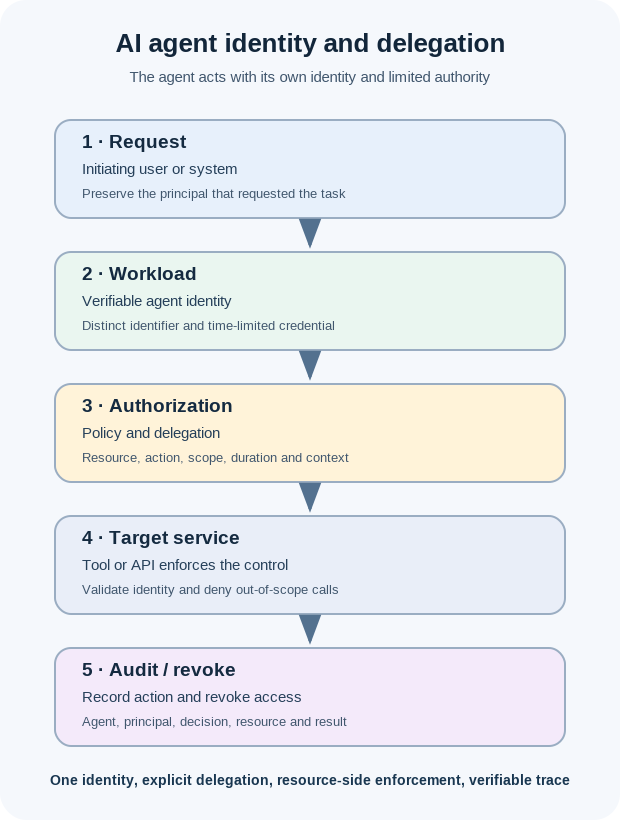
Nexxom diagram, summarizing the IETF AIMS Internet-Draft and identity controls described by NIST. It illustrates a model, not a mandated implementation.
In this model, a person or system requests a task. The agent authenticates as a separate workload. An authorization server checks who initiated the task, what the agent needs to do and which resource is involved. The target service enforces the decision. An audit trail then makes it possible to reconstruct the action and withdraw access if risk changes.
Agent, user and delegation are different concepts
An agent should have its own technical identity, but that does not automatically make it the owner of every permission needed for a task. Keep three questions separate: which actor made the call, who requested the action and what operation was authorized.
RFC 8693, OAuth 2.0 Token Exchange, distinguishes delegation from impersonation. In a delegated action, the agent keeps its own identity and explicitly acts on a user's behalf. With impersonation, the call appears to come from the user. That difference determines whether a log can show which software actor made the decision.
| Question | Value to preserve | Mistake to avoid |
|---|---|---|
| Which workload made the call? | Stable identifier for the agent or workload | One service account shared across multiple agents |
| Who requested or authorized the task? | Identity of the initiating user or system | Dropping the original principal during delegation |
| What action was permitted? | Resource, operation, scope, duration and context | Inheriting every permission held by the user |
| How can the outcome be explained? | Access decision linked to the task | A log that only records which model was used |
This distinction matters even when an agent stays inside the corporate network. It helps attribute a change, revoke access, investigate an incident and limit the impact of an error. Our article on securely connecting agents through MCP covers protocol access to tools. This article focuses on the agent's authority and how it is represented across systems.
Which authorization model fits the task?
The right model depends on the task. An agent reading public documents to draft a summary should not have the same access as one that edits customer records or initiates a payment. Make decisions about the action and resource, not just the broad category “AI agent.”
| Situation | Principal to preserve | Suggested authorization | Human control |
|---|---|---|---|
| Read-only research or summarization | Agent and requesting user | Read only the required sources, for the task's limited duration | Sample review or review on request |
| Updating a business record | Agent, user and affected record | Write access to a specific scope, schema validation and an event log | Approval based on the change's impact |
| Financial, administrative or irreversible action | Agent and principal authorizing each operation | Transaction scope, value limit and short expiry where supported | Independent confirmation before execution |
| Task started by a scheduled system | Identity of the initiating job and the agent's own identity | Separate service rights for explicitly permitted resources | Alert and automatic stop on anomalies |
The NIST AI Risk Management Framework and its Measure Playbook can help place these choices within risk analysis and operational monitoring. They do not require a specific identity provider or protocol.
Use short-lived, narrowly scoped credentials
API keys copied into a prompt, shared configuration file or logs do not always show which agent acted, and removing them can have collateral effects. NIST notes that whoever holds an API key or bearer token can often present it. The risk grows when durable secrets are propagated across an agent, tool, model and service.
The AIMS draft treats provisioning as a runtime process: a system verifies the workload and its state, then issues a credential with an expiry. It discusses workload identities, including SPIFFE, along with certificates or signed tokens depending on the architecture. The SPIFFE overview explains the principle of workload identifiers and credentials. RFC 9700, OAuth 2.0 Security Best Current Practice, provides general recommendations for enterprises choosing OAuth.
When an agent must call multiple services, token exchange can provide credentials better suited to a downstream service. RFC 8693 defines the exchange protocol, but it does not decide business policy, duration or the trust model on its own. The team must confirm that the authorization server actually reduces permissions and that the target service validates audience, scope, expiry and principal. The IETF presents this as a composable mechanism, not an automatic security solution.
| Credential check | Design question |
|---|---|
| Identity | Is the token bound to the expected workload instead of a generic account? |
| Audience | Is it accepted only by the intended recipient service? |
| Scope | Does it limit access to the resources and operations needed for this task? |
| Duration | Does it expire quickly enough to reduce exposure after a leak? |
| Delegation | Can the service distinguish the agent from the principal it represents? |
| Revocation | Does disabling access invalidate related sessions and caches? |
The OWASP AI Agent Security Cheat Sheet also recommends least privilege, per-tool permissions and explicit authorization for sensitive operations. Our analysis of MCP agent permissions adds the risks of actions triggered by untrusted input.
Audit and revocation must follow the action
A useful audit trail answers five questions: which agent called which tool, on whose behalf, to do what, with what access decision and when? The AIMS draft adds the need to retain authorization context and respond to risk or revocation events. It proposes that affected systems remove or reduce access when authorization is no longer valid. Because the document is a draft, these statements describe the authors' proposed requirements, not obligations already standardized.
| Event to record | Useful operational fields |
|---|---|
| Request allowed or denied | Agent ID, initiating principal, resource, action and decision |
| Token issued or exchanged | Issuer, audience, scope, expiry and correlation ID |
| Action executed | Tool, result, timestamp and task reference |
| Permission changed or revoked | Reason, actor, effective time and state of related sessions |
| Incident or unexpected behavior | Observed signal, remediation and final state |
Avoid logging secrets or complete conversation contents by default. A task ID, resource references and authorization events may be enough for an investigation while limiting retained personal data. Define who can access traces, for how long and for what purpose.
A pragmatic five-step rollout
- Inventory. List agents, tools, owners, runtime environments and technical identities. Include prototypes and personal agents installed on workstations.
- Separate. Assign a distinct identifier to each agent or workload. Distinguish it from the employee, scheduled job and service account.
- Define authority. For each task, record who requests it, which resources the agent may read or change, for how long and which actions require confirmation.
- Issue and revoke. Prefer runtime-issued, short-lived, narrowly scoped credentials. Test rotation, revocation and behavior when the identity provider is unavailable.
- Audit. Confirm that a team can reconstruct a task end to end and remove an agent's access without disabling a person's account.
For local agents, legacy systems or providers that cannot accept delegated tokens, moving immediately to workload identity may not be possible. Start by storing the secret in a vault, creating a dedicated and restricted account, shortening its validity where possible, blocking use outside the runtime and documenting a removal plan. This temporary control does not replace verifiable delegation.
What an enterprise can decide now
The IETF AIMS draft does not require replacing existing IAM systems or adopting a new product. It offers a way to examine gaps between workload identity, business authorization, propagation of the user principal, audit and revocation. The scope is still evolving because version 00 is an informational Internet-Draft published on 15 September 2026.
For some teams, the first task will be to remove shared keys and give every agent a separate identity. For others, the main gap will be preserving delegation in logs or revoking an in-flight permission. In every case, an agent should receive no more authority than a defined task requires.
The practical question is not only “which model does the agent use?” It is “which actor can perform which action, for whom, on which resource, for how long, and how can that access be stopped?” An identity and authorization review answers that question before agents spread across business processes.
Sources checked on 16 September 2026
- IETF, AI Identity Management System, draft-ietf-wimse-aims-00, informational Internet-Draft, published 15 September 2026.
- NIST NCCoE, Why Agentic AI Needs a Strong Identity Foundation, published 27 August 2026.
- RFC 8693, OAuth 2.0 Token Exchange, delegation and impersonation semantics.
- RFC 9700, Best Current Practice for OAuth 2.0 Security.
- NIST, AI Risk Management Framework and Measure Playbook.
- SPIFFE, Overview.
- OWASP, AI Agent Security Cheat Sheet.