How to choose an AI model for your business in 2026
The highest-ranked public model is not automatically the best system for your business. This method compares real task quality, critical failures, latency, total cost, data controls and operability before production.
Choosing an artificial intelligence model in 2026 is not a matter of picking the leader of a public ranking. The right choice is the model that reaches your quality threshold on your tasks, respects your data constraints and remains operable at the required cost and latency. The decision therefore covers a complete system: model, prompt, context, tools, controls and human oversight.
Short answer
Start with a use case and unacceptable failures, not a vendor. Evaluate three to five candidates on a representative test set. Eliminate options that fail quality, security or hosting gates. Then compare cost per successful task, latency, integration and dependency risk. For many businesses, the result is not one universal model. It is a portfolio with a compact default model and a more capable model for difficult cases.
Five decisions that matter
- Define the task, users and cost of an error.
- Set hard constraints before comparing scores.
- Test the complete system on data close to production.
- Measure the cost of an acceptable outcome, not only token price.
- Plan versioning, monitoring and a replacement path from the start.
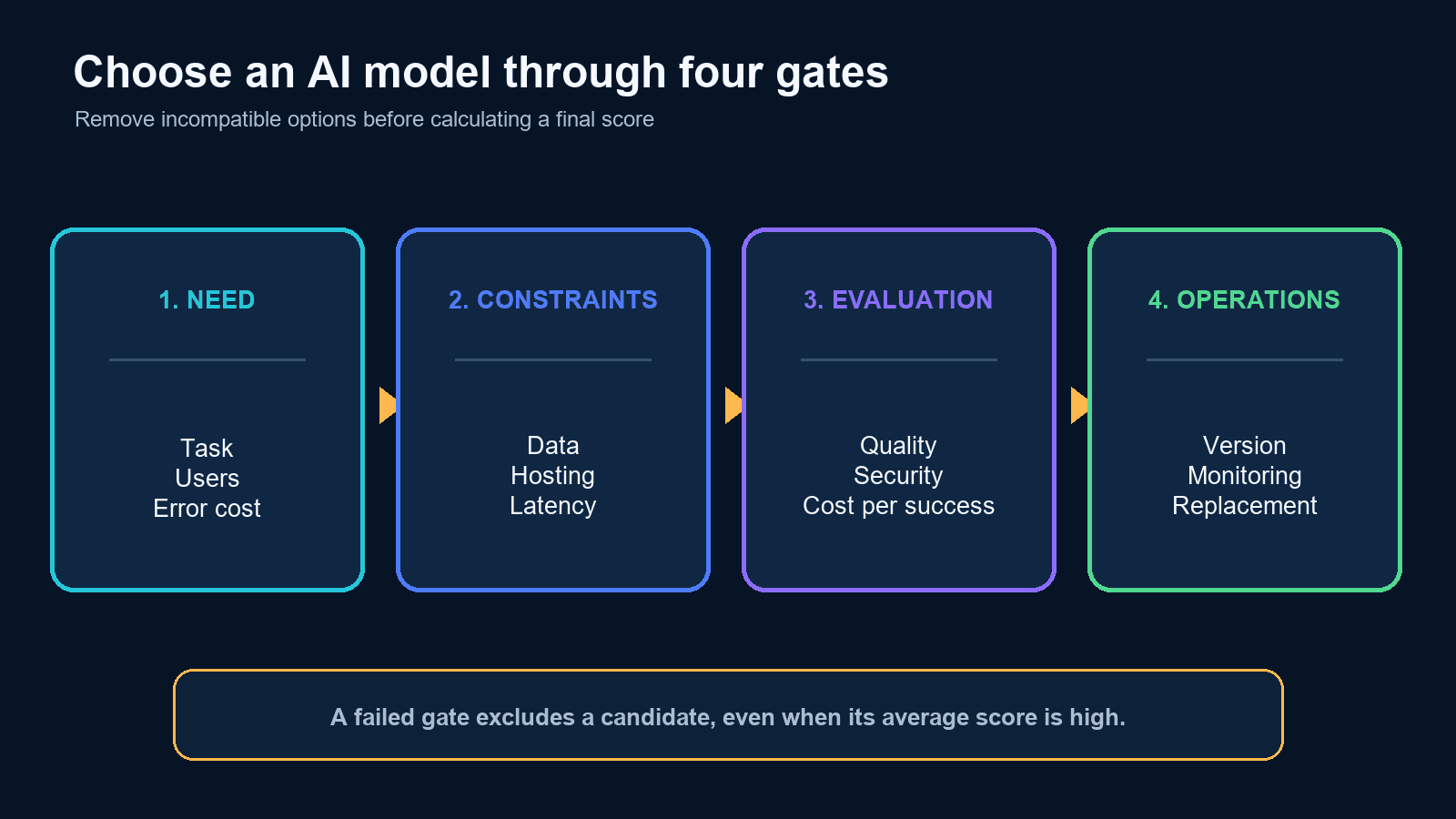
Nexxom selection framework. Each gate can remove a candidate before the final comparison.
Why the top-ranked model can be the wrong choice
A public benchmark answers a question defined by its dataset, protocol and metric. In February 2026, NIST AI 800-3 distinguished accuracy on the questions included in a benchmark from generalized accuracy across a broader population of similar questions. Two models may appear separated by an observed score even when the gap becomes less clear after uncertainty and generalization are considered.
Public rankings remain useful for building a longlist. They rarely measure your domain language, documents, operating languages, tools, abstention requirements, most expensive failures or infrastructure. The NIST AI RMF also recommends demonstrating performance in conditions similar to deployment and monitoring the system in production.
The useful question is not "which model is best?" It is "which candidate completes this process, under these constraints, with acceptable residual risk?"
What the 2026 market changes in model selection
Providers now organize model families around capability, speed and cost trade-offs. The names below were verified in official documentation on 6 August 2026. They illustrate available options. They are not a Nexxom benchmark or a universal recommendation.
| Family | Official examples on 6 August 2026 | Provider positioning | What you still need to verify |
|---|---|---|---|
| Proprietary general-purpose API | OpenAI GPT-5.6 Sol, Terra and Luna | Capability, balance or volume depending on the variant | Business quality, data residency and use, actual cost, version stability |
| Multicloud general-purpose API | Anthropic Claude Fable 5, Opus 5, Sonnet 5 and Haiku 4.5 | Capability, agentic work, speed and multiple cloud channels | Effective availability, pinned version, tools, quotas and data policy |
| Google multimodal API | Gemini 3.6 Flash, 3.5 Flash-Lite and 3.1 Pro in preview | Multimodality, speed, agentic tasks and reasoning | Stable or preview status, shutdown date, alias behaviour and region |
| Specialist or open-weight model | Mistral Small 4, Mistral Large 3, Ministral 3, plus OCR, audio and moderation models | General, specialist, compact and open-weight options | Exact licence, hosting capacity, hardware, security and operating cost |
These descriptions come from the providers. They do not prove that one product beats another for your use case. Google's catalog, for example, distinguishes stable, preview, latest and experimental identifiers, with different stability implications. Anthropic documents pinned snapshots. Mistral lists the licence attached to each model. Lifecycle details matter as much as raw capability when an application must operate for years.
Step 1: frame the use case and risk
Describe an observable task. "Improve customer service with AI" is too broad. "Route a request, extract the order number and draft a sourced answer for an adviser to approve" can be evaluated.
The brief should specify:
- users, languages and expected volumes;
- input and output formats;
- required knowledge and tools;
- personal, sensitive or confidential data;
- actions the system may execute;
- tolerable, major and critical failures;
- situations that require abstention or human approval;
- latency, availability and recovery objectives;
- budget per business operation, not only per API call.
For invoice extraction, a punctuation error matters little, while an incorrect amount or supplier may be critical. For an agent, a polished answer does not compensate for selecting the wrong tool or taking an unauthorised action. Metrics must follow actual risk.
Step 2: choose the delivery model before the model name
Deployment constraints often reduce the shortlist faster than a benchmark.
| Option | Prefer it when | Limitation to examine |
|---|---|---|
| Managed general-purpose API | You need rapid delivery, access to recent capabilities and limited infrastructure operations | Provider dependency, data terms, quotas and version changes |
| API through an established cloud | Teams already govern contracts, identities, networks and controls in that cloud | Different catalog, regions, release lag and channel pricing |
| Self-hosted open-weight model | Environmental control, customization or isolated execution is decisive | MLOps skills, hardware, optimization, patches, monitoring and licence |
| Specialist model | The task is narrow, such as OCR, transcription, embeddings or moderation | Narrower coverage and orchestration of several components |
| Portfolio or router | Tasks have very different difficulty, risk or volume profiles | Evaluation complexity, routing rules, observability and response consistency |
A local model is not automatically cheaper or more private. Account for accelerators, power, unused capacity, staff, updates and logs. An API is not automatically incompatible with sensitive data. Verify the contract, region, retention, training policy, encryption and controls. The decision depends on contractual and technical evidence.
Step 3: build an evaluation that resembles real work
The OpenAI Model Selection Guide recommends meeting an accuracy target first, then reducing cost and latency with a smaller model if quality remains acceptable. This provider guidance reflects a useful engineering principle: a fast, inexpensive model that fails the task creates no value.
Build a versioned dataset with common, difficult, rare and adversarial cases. Include the languages, formats and lengths encountered in production. Keep a final set outside the improvement loop. Use the same prompt, tools, documents and parameters for each candidate unless you intend to compare separately optimized systems. In that case, document each configuration.
OpenAI's evaluation best practices recommend task-specific tests, a combination of metrics and human judgment, and continuous evaluation. They also identify generic metrics and impression-based judgments as weak approaches.
An adaptable decision matrix
The matrix below is a Nexxom example, not a standard. Hard gates are applied before the weighted score.
| Criterion | Illustrative weight | Possible measure | Hard gate |
|---|---|---|---|
| Business quality | 30% | Share of tasks accepted against an explicit rubric | Yes, below the minimum |
| Critical failures and security | 15% | Severe error, leakage, unauthorised action and incorrect refusal rates | Yes, depending on risk |
| Data and compliance | 15% | Region, retention, training, access, audit and contract | Yes |
| Latency and throughput | 10% | p50, p95, time to first result and sustained throughput | Yes when the experience requires it |
| Cost per successful task | 10% | Total cost divided by accepted outcomes | No, after quality |
| Integration and tools | 10% | Structured output, tool calls, SDKs and observability | Depends on architecture |
| Lifecycle and portability | 10% | Pinned version, notice, replacement and reversibility | Depends on criticality |
Define scoring examples before running the test. A weighted average must never hide a failed gate. A model scoring 88 out of 100 is still excluded if it breaches a data residency rule or produces a critical failure category.
Measure cost per successful task
Published price per million tokens is insufficient. Use:
cost per successful task = total system cost during the test / number of accepted tasks
Total system cost includes input, output, tools, retrieval, cache, retries, human review and infrastructure. A cheaper model per token can cost more if it produces long responses, needs repeated attempts or increases human review. A more capable model is not economical when a compact variant already meets the threshold.
For self-hosted infrastructure, measure several load scenarios. MLPerf Inference v5.1 illustrates the value of reproducible scenarios that separate throughput and interactive latency constraints. Those results compare systems under their protocols, not your full application.
Step 4: decide for a portfolio, not forever
A robust answer is often a routing policy. A compact model handles frequent, straightforward requests. A more capable model receives complex cases. A specialist component handles OCR, transcription, embeddings or moderation. Sensitive actions pass through deterministic controls and human approval.
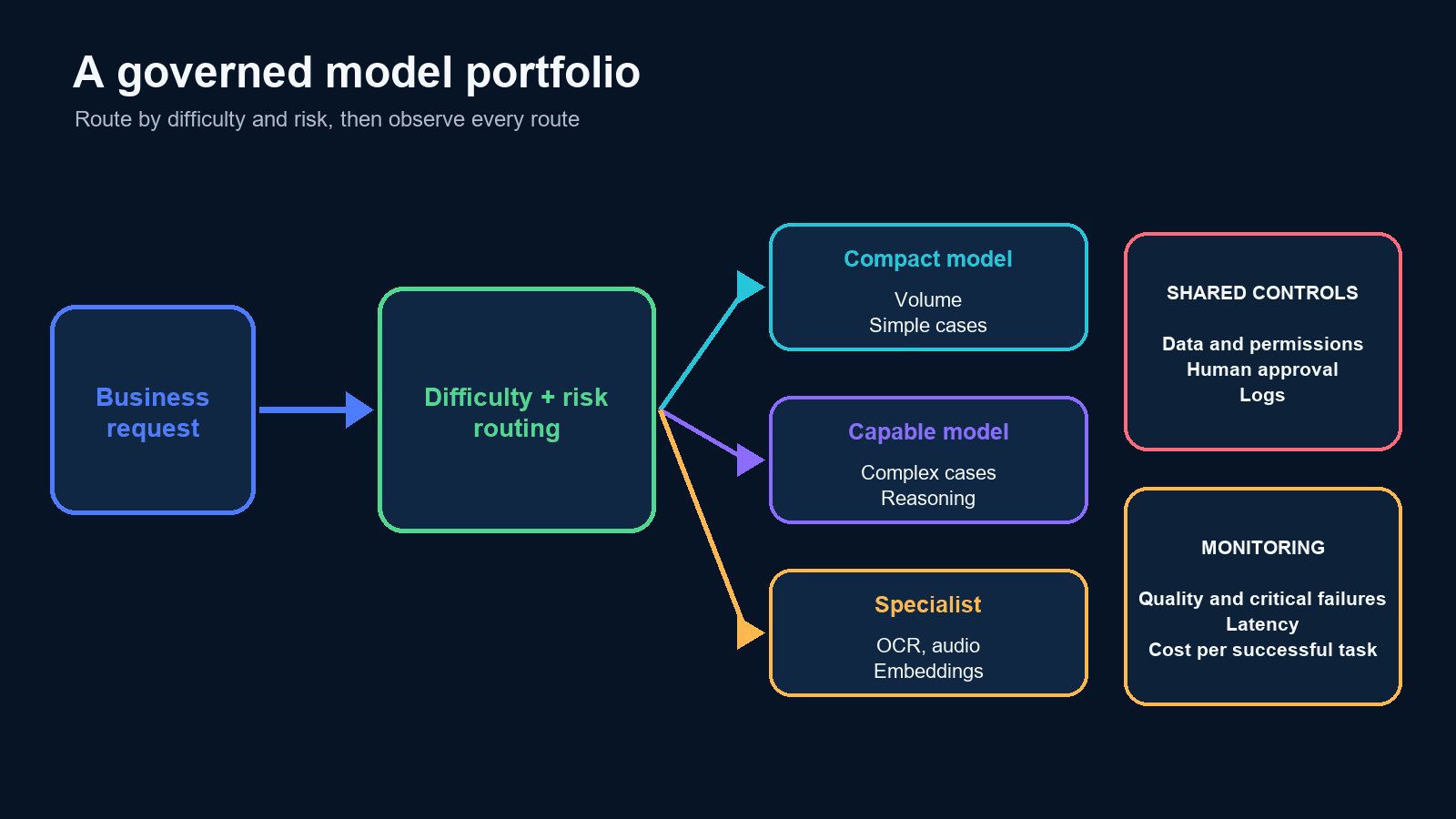
Nexxom reference architecture. Routing reduces cost only when it remains measurable and governed.
This approach avoids paying for maximum capability on every request. It also creates responsibilities: test the routing rule, record which model handled each task, compare failure rates by route and maintain a consistent user experience.
Which option fits each scenario?
| Situation | Recommended starting point | Why |
|---|---|---|
| Business prototype with standard requirements | Managed API and balanced model | Fast integration and straightforward instrumentation |
| Complex decision with low volume | Highly capable model, then test a compact variant | Quality dominates first, optimization follows |
| Repetitive high-volume task | Small model, specialist model or routing | Cost and throughput become material once quality is met |
| Highly constrained data or isolated environment | Self-hosted open weights or a contractually suitable private offer | Control over environment and data flows |
| Documents, audio or images | Native multimodal model or specialist component | Avoids fragile conversions and measures each modality |
| Agent that executes actions | Reliable tool use, least privilege and approval controls | Safe action matters more than eloquence |
| Long-lived critical application | Pinned versions, regression tests and a backup provider | Reduces change risk and speeds migration |
Common selection mistakes
- Choosing a brand before defining the task.
- Treating the advertised context limit as proof of long-document quality.
- Comparing models with different prompts or tools without disclosing it.
- Optimizing token price before reaching the success threshold.
- Hiding critical failures inside an overall average.
- Testing only English when production is multilingual.
- Using a moving alias without regression tests and rollback.
- Assuming open weights remove security and operating duties.
- Deploying one model when tasks have opposing requirements.
A 30-day selection plan
- Week 1, framing. Define the task, constraints, error cost, rubric and hard gates.
- Week 2, test set. Gather authorised examples, annotate them, separate development and validation, and prepare adversarial cases.
- Week 3, comparison. Run candidates in documented configurations and measure quality, risk, latency and cost per success.
- Week 4, pilot. Test with users, validate human controls, pin the version and establish alerts, budgets and replacement procedures.
The decision should produce an auditable record: model version, configuration, test data, segmented results, known failures, owner, review date and retirement criteria.
Frequently asked questions
Should we always start with the most powerful model?
No. Use it as a reference when quality is difficult to reach, then test whether a compact option retains the threshold. If latency, hosting or budget are hard gates, filter out candidates that cannot satisfy them before deeper testing.
Is an open-source model always better for sensitive data?
No. Open weights, licence, source code and hosting service are different concepts. Privacy depends on architecture, access, logs, patches, contracts and operations. Compare that evidence with a managed or private offer.
How many models should we test?
Three to five well-chosen candidates are often enough for an initial decision. The goal is not to cover the whole market. Represent deployable choices: a reference model, a balanced option, a compact option and, where relevant, a specialist or self-hosted option.
When should the evaluation be repeated?
After a model, version, prompt, data source, tool, routing or security policy changes. Re-run tests at regular intervals and expand them with incidents and requests observed in production.
Conclusion
In 2026, choosing an AI model is an engineering and governance exercise. Rankings help exploration. A decision comes from representative evaluation, explicit constraints and cost per useful outcome. Start with a capable reference, remove incompatible options, optimize only after reaching required quality and maintain a replacement path.
Nexxom can turn this framework into an evaluation protocol, deployment architecture and production dashboard tailored to a real business process.
Primary sources
- NIST AI 800-3: statistical validity of model evaluations, 2026
- NIST AI RMF Core: Govern, Map, Measure and Manage
- OpenAI: Model selection
- OpenAI: Evaluation best practices
- OpenAI: model catalog
- Anthropic: Claude models overview
- Google: Gemini models
- Google: Gemini deprecations
- Mistral AI: models overview
- MLCommons: MLPerf Inference v5.1
Information and catalogs verified on 6 August 2026. Models, pricing and terms change. Check official pages before any purchase or deployment decision.