LLM-as-a-judge: when can automated evaluation be trusted?
LLM judges reduce review cost, but one score is not ground truth. Learn how to make automated decisions comparable, auditable and useful.
Short answer
An LLM-as-a-judge is a model that evaluates another model's output against an instruction and a rubric. It can reduce review cost, but its score is neither independent truth nor a probability of success. Confidence comes from the protocol: a representative task, observable criteria, randomized answer order, automated checks, a human sample, agreement measures and an abstention rule.
The right mental model is an instrument, not an oracle. Record the judge version, prompt, data, decisions and uncertainty. For a consequential decision, automation can triage or flag and a person arbitrates. For high-volume optimization, a judge can provide a fast signal when calibration is checked regularly.
Why a leaderboard is not enough
Public leaderboards aggregate preferences, but rarely answer an operational question: does a model follow our constraints, cite the right sources, respect a schema and refuse prohibited requests? Our guide to evaluating an LLM beyond public leaderboards explains how to translate benchmarks into real tasks.
The foundational MT-Bench and Chatbot Arena work found that a strong judge can reach more than 80% human agreement on selected conversations, while documenting position, verbosity and self-enhancement biases (Zheng et al., 2023). G-Eval reports better correlation on summarization and dialogue when a rubric is explicit, while also discussing a preference for LLM-generated text (Liu et al., 2023). Neither result proves that a judge is valid for your domain.
The minimum protocol, from task to decision
The deterministic flow below separates the judge's signal from checks that can contradict it.

Nexxom diagram: an automated score becomes useful only after independent checks and human calibration.
- Define the task. Keep a versioned case set with language, length, difficulty and sensitive-data attributes. Keep development cases separate from the control set.
- Write an observable rubric. Prefer binary or anchored criteria such as factual accuracy, requirement coverage, safety, format and tone. Include a positive and a negative example without leaking the expected answer into evaluation cases.
- Choose a comparison mode. Pairwise answers “A or B?”. Pointwise gives a score to one answer. The first is convenient for an A/B test, the second for a time series. Preserve the raw verdict and rationale in both cases.
- Separate judgement from evidence. A JSON parser, citation test or business rule should run independently. A response that fails a blocking constraint should not be rescued by fluent prose.
- Randomize and repeat. Swap A/B order, hide model names and repeat unstable cases. An average without dispersion hides verdict reversals.
- Calibrate with people. Have trained annotators label a sample. Measure agreement among people, judge-human agreement and disagreement by criterion.
- Decide or abstain. Define an operational confidence rule. If scores are close, a critical criterion disagrees or the distribution leaves the calibrated domain, route to human review.
Which judge for which use case?
| Mode | Question | Strength | Risk to monitor |
|---|---|---|---|
| Pairwise | Which answer is preferable? | Sensitive to small differences | Position and majority effects |
| Pointwise | Does this answer meet the bar? | Longitudinal tracking | Miscalibrated scale, score inflation |
| Reference-based | Does it match a known truth? | Factuality control | Incomplete or stale reference |
| Reference-free | Is it useful and clear? | Creative tasks | Style mistaken for quality |
For an RAG system, use a faithfulness judge separately from retrieval tests. For an agent, evaluate the trace too: tool calls, sequence, permissions and stops. Our article on production agent traces covers this output-plus-process view.
Biases to measure, not merely mention
A judge may prefer the first answer, the longer answer or a style resembling its own outputs. Measure it with controlled pairs: identical content in reversed order, the same answer shortened, the same meaning reformulated or an answer generated by another model. Recent research also highlights run-to-run instability and the risks of shared calibration (Soumik, 2026, Fiedler, 2026).
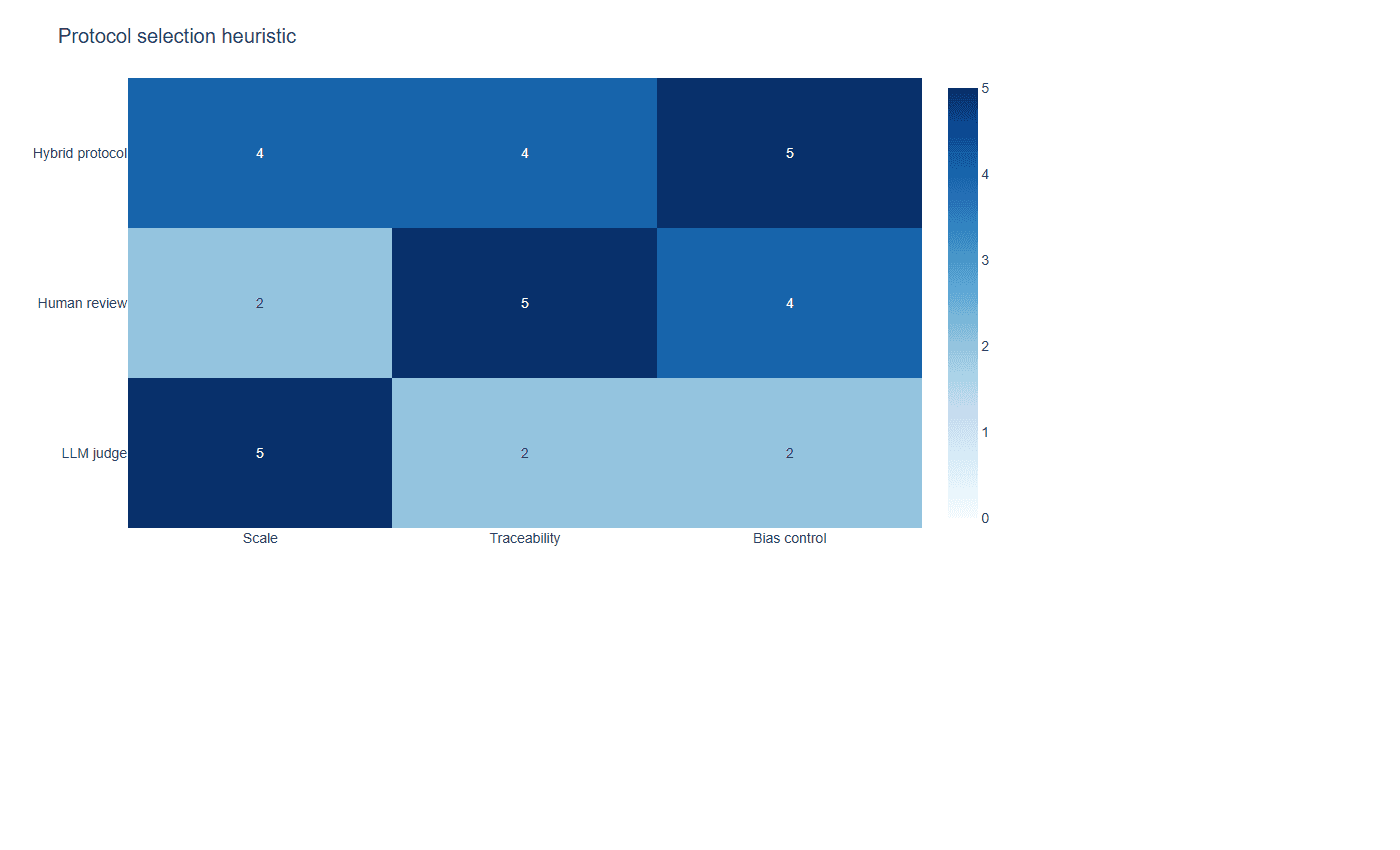
Nexxom Plotly matrix: heuristic scores from 0 to 5 for trade-off discussion. It is not a NIST measurement or a benchmark.
| Robustness test | Construction | Warning signal | Action |
|---|---|---|---|
| Position | A/B then B/A | Verdict flips | Randomize and aggregate |
| Length | Concise and expanded versions, same facts | Systematic length preference | Add coverage criterion |
| Style | Neutral reformulation of same content | Score changes without factual gain | Mask style in rubric |
| Temperature | Repeated calls at fixed settings | High variance | Repeat or abstain |
| Model | Two judges from different providers | Structural disagreement | Human arbitration and slice analysis |
Do not turn a repetition count into a universal rule. The useful number depends on observed variance and the cost of an error. Report the distribution or interval of verdicts instead of an invented confidence.
Measure agreement and uncertainty
A global agreement rate hides difficult cases. Keep a confusion matrix by criterion, an abstention rate and stability after permutation. For ordinal scores, choose an agreement statistic that matches the scale and publish the calculation. A small human sample can reveal a behavior change, but cannot prove general equivalence.
| Indicator | Practical calculation | Cautious reading |
|---|---|---|
| Judge-human agreement | Identical verdicts / shared cases | Depends on set and training |
| Inter-human agreement | Agreement among annotators | Sets a realistic ceiling |
| Flip rate | Changed verdicts after permutation / pairs | Measures presentation bias |
| Abstention rate | Cases routed to people / evaluated cases | Too low can signal overconfidence |
| Drift | Indicator gap between versions | Triggers revalidation |
The NIST AI RMF asks teams to document metrics, uncertainty, deployment-like conditions and production monitoring. The Measure Playbook calls for histories, errors, complaints and human oversight. The recent TEVV-Athlon framework links objectives, evidence and decisions.
Build a reproducible evaluation card
A useful card lives in a versioned repository and can be read by someone who did not write the prompt. Include: task ID, date, set version, judge model and parameters, full prompt, criteria and anchors, answer order, raw verdict, rationale, automated checks, human label, escalation rule and final decision.
Open frameworks make this discipline easier. OpenAI Evals provides a registry and private evaluations; its documentation recommends versioning an eval to preserve reproducible results. HELM demonstrates multi-metric, multi-scenario evaluation. Use these tools as components, not as proof that your use case is covered.
When should automation be rejected?
Reject a single automated verdict when an error could cause significant harm, when a reference is legally determinative or when the judge and evaluated model share data that may leak preferences. In these situations, automation can prepare a case but should not sign the decision alone.
For some teams, the best compromise is automatic triage on verifiable criteria followed by human sampling. For others, a hybrid protocol with two independent judges and a domain arbiter is safer. The decision depends on error cost, volume, data stability and the availability of appeal.
Pre-production checklist
- Does the test set represent real users, languages and edge cases?
- Are criteria observable, weighted and linked to a decision?
- Are deterministic checks separated from the judge prompt?
- Are order, style and model names neutralized?
- Does a human sample measure agreement and disagreement?
- Are abstention and appeal rules documented?
- Are versions, costs, latency and logs retained?
- Does a drift threshold trigger recalibration?
The conclusion is straightforward: an LLM-as-a-judge is trustworthy when you can explain when it is right, when it is wrong and when it must hand over. For the broader governance context, see our TEVV framework and our analysis of structured outputs.
Keep a journal that survives model changes
Retain the inputs and outputs needed for audit under a privacy-aware retention policy. Hash identifiers when content contains personal data and restrict access to approved annotators. A useful journal lets a team replay a case with the same prompt, detect distribution shifts and explain a decision to product owners. It also prevents a silent judge update from being mistaken for an improvement in the evaluated model.
Schedule a rubric review as well. Business criteria evolve, users change vocabulary and attacks change shape. An automated evaluation with no owner, review date or stop threshold eventually produces a reassuring number that no longer supports a decision. Assign an accountable owner, record exceptions and make recalibration part of the release checklist.
This operational layer connects research findings to engineering practice. It gives procurement, security and product teams a shared vocabulary for asking what was measured, under which conditions, and with which remaining uncertainty. That is the difference between an impressive demo and evidence that can support a production decision.
Record exceptions as carefully as successes. A judge that abstains on an unfamiliar language, a new product line or a safety edge case is behaving as designed if the boundary is explicit. Review those abstentions to decide whether the rubric needs a new anchor or whether the case should remain human-only. This feedback loop keeps the evaluation useful as the system, users and policies change.