Which process should you entrust to an AI agent? A 7-criterion selection method
An AI agent is worthwhile only when work variability justifies autonomy and its actions remain measurable, controlled and economically useful. Use these seven criteria to select the right process.
The best process to entrust to an AI agent is not necessarily the longest or most expensive one. It is a process whose path changes with context, requires interpretation of unstructured information and produces an outcome that can be evaluated. It also needs controlled tools, a named owner and explicit action boundaries. When the steps can be described with stable rules, conventional automation will often be more reliable, less expensive and easier to audit.
Short answer
Before building an AI agent, compare four options: keep the work human, automate it with rules, place a model inside a bounded workflow or let an agent choose some steps and tools. A strong agent candidate combines ambiguity, variable paths, unstructured data, measurable business value and verifiable outcomes. It is still unsuitable if irreversible actions cannot be blocked, permissions are too broad or no team can evaluate and operate it.
The Nexxom framework in this article scores seven criteria. It structures a discussion and enables comparison across processes. It does not replace a risk assessment, testing on real data or a compliance decision.
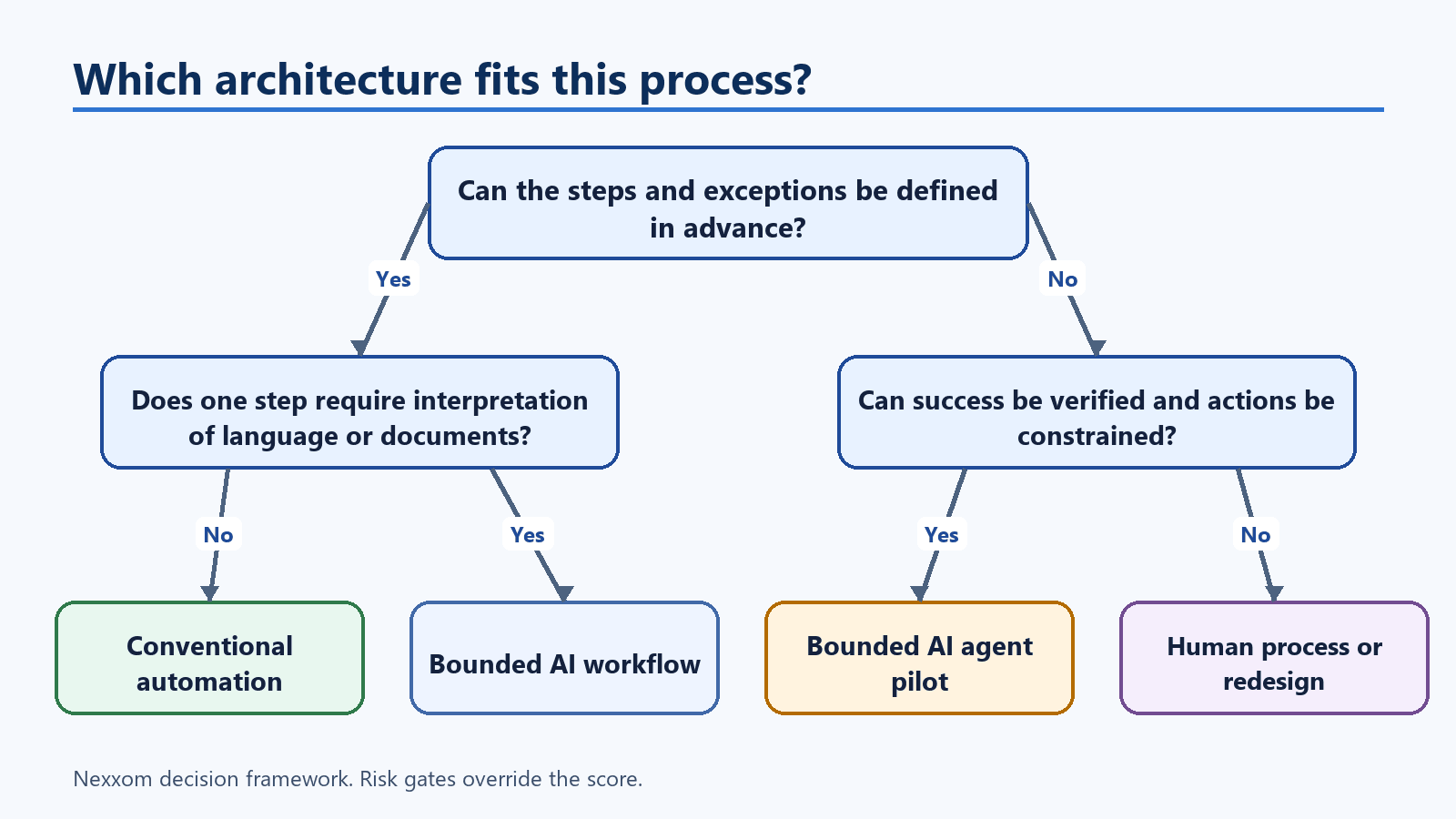
Nexxom decision tree. A risk or evaluation gate can stop the project even when the process appears suitable for an agent.
What distinguishes an AI agent from automation?
Conventional automation follows a path defined in advance. Rules determine the next step, the data to read and the action to perform. A bounded AI workflow adds one or more models to that path without giving them overall control of execution. A model might classify a request or extract data, after which software applies deterministic rules.
An AI agent goes further. It uses a model to decide how to pursue an objective, select tools and determine whether the work is complete within system boundaries. This definition is consistent with OpenAI's practical guide to building agents and Anthropic's distinction between workflows and agents.
| Option | Who chooses the next step? | Suitable when | Main limitation |
|---|---|---|---|
| Human process | A person | Work is rare, poorly defined or too risky to automate | Capacity, lead time and human variability |
| Conventional automation | Rules and code | Inputs, decisions and exceptions are stable | Rules become brittle when context varies widely |
| Bounded AI workflow | Code orchestrates, the model interprets | One step requires language or documents but the path remains known | Every model output needs evaluation and an abstention path |
| Bounded AI agent | The model chooses among authorised tools and steps | The path cannot be fully predicted and success remains verifiable | Higher cost, latency, variability, security and operating complexity |
This distinction avoids a false choice between no AI and a fully autonomous agent. In many projects, the best system is hybrid: a model interprets, a workflow controls state and a person approves sensitive actions.
Seven criteria for selecting an agentic process
1. Does the work contain useful ambiguity?
An agent can add value when the process requires understanding intent, reconciling information, handling exceptions or adapting a plan. OpenAI identifies three relevant families: complex decisions, rules that have become difficult to maintain and heavy use of unstructured data. When the same input should always produce the same action under a known rule, useful ambiguity is absent. A rules engine is preferable.
The ambiguity must contribute to the outcome. Adding a model to a simple data-copying task creates no useful reasoning. It only introduces another source of failure.
2. Does the execution path genuinely vary?
A predefined workflow is appropriate when the steps can be drawn before execution. An agent becomes interesting when the order of searches, checks or tools depends on findings made during the task. Anthropic nevertheless recommends starting with the simplest solution that works and adding complexity only when required.
Ask a concrete question: across fifty representative cases, how many require a different path that cannot be described cleanly with a few branches? If variations are known and limited, conventional routing remains more predictable.
3. Is business value observable?
An agentic process must create a measurable operational or economic outcome: a correctly prepared case, a resolved request, a qualified incident, a shorter lead time or less manual work. The number of steps and the novelty of a demonstration do not measure value.
Define the unit of outcome before prototyping. It could be an application accepted without major rework or a request routed to the correct team with the required evidence. Then calculate cost against that unit, including models, tools, retries, human controls and operations.
4. Can the required data and tools be accessed safely?
An agent without reliable tools cannot execute a process. An agent with excessive permissions can create disproportionate risk. Each tool needs a clear function, constrained inputs, explicit errors and minimum permissions. Read, propose and write capabilities should be separated where risk requires it.
The NIST AI Agent Standards Initiative places identity, authorisation and interoperability among the priorities for agentic systems. Use-case preparation must therefore cover service identities, secrets, data sources, logging and network boundaries, not only the prompt.
5. Can success be verified?
A process is not ready for an agent if nobody can recognise a correct execution. Define the expected outcome, critical failures, abstention cases and review procedure. Tests must cover the complete path: interpretation, plan, tool selection, arguments passed to tools, permission compliance and final outcome.
NIST AI 800-2 notes that agent evaluations need explicit tools, instructions, budgets and stopping conditions. For a broader evaluation protocol, see our guide to evaluating an LLM beyond public leaderboards.
6. Are failures detectable and reversible?
An agent's ability to act does not mean it should act alone. Research, drafts and recommendations can often be reversed or reviewed. Payments, deletion, regulated decisions or transmission of sensitive information require stronger barriers.
OpenAI recommends human intervention for sensitive, irreversible or high-stakes actions. Controls can include prior approval, limits, dual validation, simulated execution, an isolated environment or a rollback tool. If no measure reduces risk to an acceptable level, the process is not a good candidate for autonomy.
7. Can a team own and operate the system?
A production agent is a service, not a one-off prompt. It needs a business owner, a technical owner, an incident procedure, regression tests, version monitoring and a budget. Logs must connect an outcome to relevant data, tools and observable decisions without unnecessarily exposing sensitive information.
The NIST AI RMF Core calls for documented roles, benefits, costs, limits and human oversight, followed by measurements under deployment-like conditions. Without operating capacity, even a compelling prototype remains a poor production candidate.
A scoring grid for a selection workshop
Assign 0, 1 or 2 points to each criterion. The total indicates potential fit for an agent. It never overrides a hard gate.
| Criterion | 0 points | 1 point | 2 points |
|---|---|---|---|
| Ambiguity | Stable, explicit rules | Some interpretive exceptions | Frequent contextual judgement |
| Path variability | Fixed steps | Many but known branches | Steps discovered during execution |
| Observable value | Outcome or volume not measured | Plausible value, incomplete measure | Outcome unit, volume and baseline known |
| Data and tools | Uncontrolled access or missing tools | Partial access, controls incomplete | Testable tools, minimum rights and authorised data |
| Verifiability | No reference outcome | Human review possible but slow | Criteria, tests and critical failures defined |
| Reversibility | High-impact actions are not blocked | Some actions require approval | Actions are reversible or controlled before execution |
| Operability | No owner or monitoring | Partial responsibilities | Owners, logs, budget and incident process |
How should you interpret the total?
- 0 to 4 points: retain the human process or use simple deterministic automation.
- 5 to 8 points: test a bounded AI workflow on one step without giving the model overall control.
- 9 to 11 points: consider a bounded agent pilot with few tools and human approval.
- 12 to 14 points: the process may justify broader autonomy, but only after risk gates, evaluations and an observed pilot.
These thresholds are a Nexxom framing method, not a standard. A high score cannot compensate for prohibited data, an uncontrolled irreversible action or the absence of an accountable owner.
Hard gates before any prototype
Stop or redesign the use case while any of these conditions remains true:
- the expected outcome cannot be defined or evaluated;
- the required data is not authorised for the use;
- the agent would have broader permissions than the process requires;
- a critical failure could be executed without detection or approval;
- no stopping condition or limit on time, calls or cost exists;
- no owner can suspend the service and handle an incident;
- the solution cannot be compared with an existing human or software baseline.
The NIST AI 800-5 report published in May 2026 reports broad agreement among consultation respondents that agents introduce novel threats and require adaptation of established cybersecurity practices. These gates are not a formality after prototyping. They are part of use-case selection.
Which architecture fits each process?
| Process | Starting point | Why | Decisive control |
|---|---|---|---|
| Copy validated data between two systems | Conventional automation | Inputs and destination are known, with no useful interpretation | Schema validation and error handling |
| Extract contract fields and save them | Bounded AI workflow | The model reads text while code controls fields and writing | Confidence threshold and review of critical fields |
| Prepare a vendor questionnaire response | AI workflow or bounded research agent | Sources and questions vary, but the response is reviewable | Mandatory citations and approval before sending |
| Triage an IT incident from logs and procedures | Bounded agent | The investigation path depends on evidence and available tools | Read-only access, budget, traceability and escalation |
| Authorise an exceptional payment alone | Do not automate autonomously | High impact and sensitive decision | Human approval and separation of duties |
| Schedule appointments under stable rules | Conventional automation with a natural-language interface | Conversation varies, calendar constraints do not | Availability rules and final confirmation |
This table does not replace local analysis. The same process changes category with its data, permissions and impact. Read-only incident triage has a different risk profile from an agent authorised to modify infrastructure.
How do you build a pilot that produces evidence?
1. Establish a baseline
Measure the current process using useful units: handling time, rework rate, critical failures, full cost and user satisfaction. Without a baseline, the pilot cannot show improvement or degradation.
2. Narrow the scope
Choose one objective, one user group and few tools. Begin in read-only or proposal mode. Permissions and approvals highlighted in the OpenAI Skill Lab of 5 May 2026 should be designed before the pilot opens.
3. Define metrics and budgets
Track at least:
- accepted-task rate under an explicit rubric;
- critical-failure and unauthorised-action rates;
- correct abstention and escalation rates;
- human rework per task;
- duration, tool calls and cost per accepted task;
- incidents, near misses and user feedback.
Set a stopping condition and limits on turns, time, tool calls and spend. An agent that eventually succeeds after unpredictable consumption is not yet an operable system.
4. Compare three architectures
Where possible, test the same task with automation, a bounded AI workflow and an agent. This comparison reveals whether autonomy creates real incremental value. It avoids attributing to the agent concept an improvement that actually comes from better extraction or better data access.
5. Decide against written criteria
The final decision should be stop, redesign, continue in assisted mode or expand gradually. Record the model version, tools, permissions, tests, known limits, owner and review date. For the model decision itself, use our method for choosing an AI model for your business.
Frequently asked questions
Is a chatbot an AI agent?
Not necessarily. A chatbot that answers a question without directing a process or selecting tools remains a conversational application. It becomes agentic when the model controls steps, uses tools and acts towards an objective within defined boundaries.
Should you begin with a multi-agent system?
No. A single agent with few tools is easier to evaluate, secure and operate. A multi-agent system is justified only when separation of responsibilities or task structure provides a verified advantage.
Can an agent be used for a regulated process?
Sometimes, but the legal context, affected people, data and decisions require analysis. The agent may be limited to research or preparation while a person retains the decision. Legal and domain review is necessary for sensitive uses.
What is the best first permission to grant?
Read access to a necessary, constrained source is generally easier to control than write access. The system can then propose a structured action for a person to approve. Write autonomy should expand only after evaluation and sufficient observation.
How should return on investment be calculated?
Compare the full cost of the current process with the system cost per accepted task. Include models, infrastructure, tools, validation, rework, monitoring and incidents. Do not use only API-call price or time saved on successful cases.
Conclusion
A good agentic use case combines variable work with a verifiable outcome. The agent needs precise tools, minimum rights, budgets, logs and an escalation path. When the path is stable, conventional automation wins. When only one step requires interpretation, a bounded AI workflow is enough. An agent becomes relevant when flexibility creates measurable value that simpler architectures cannot achieve.
The first decision is therefore not "which agent should we buy?" It is "how much autonomy does this process deserve, under what evidence and controls?" Nexxom can turn this method into a selection workshop, evaluation protocol and pilot architecture for a real process.
Primary sources
- OpenAI: A practical guide to building agents
- Anthropic: Building effective agents
- OpenAI Academy: Build Your First Workspace Agent, 5 May 2026
- NIST AI 800-2: Practices for Automated Benchmark Evaluations, January 2026
- NIST: AI RMF Core
- NIST: AI Agent Standards Initiative, 2026
- NIST AI 800-5: Security Considerations for AI Agents, May 2026
Sources and information verified on 9 August 2026. Architectures, products and security guidance evolve. Check current documentation and applicable obligations before deployment.