Claude Opus 5 on Google Cloud: what changes for enterprises
Google Cloud says Claude Opus 5 is available on Agent Platform and compatible with Zero Data Retention. Verify access, regions, security, cost and quality on your tasks before migrating.
Google Cloud stated in its July 24, 2026 update that Claude Opus 5, described as Anthropic's latest model, was available on Agent Platform. The same announcement mentions improvements over Opus 4.8 in coding, long-running agents and knowledge work, together with Zero Data Retention compatibility. These are provider availability statements and claims, not independent proof that the model is the best choice for every enterprise.
The short answer
The announcement reduces integration friction for organizations already operating on Google Cloud: the model can be evaluated in an environment that brings together IAM, networking, logging and agent services. It does not justify an automatic migration. Before deciding, verify actual access to your project, regions and processing terms, retention settings, total cost, supported tools and quality on private tasks. Start with a reversible pilot and a reference model.
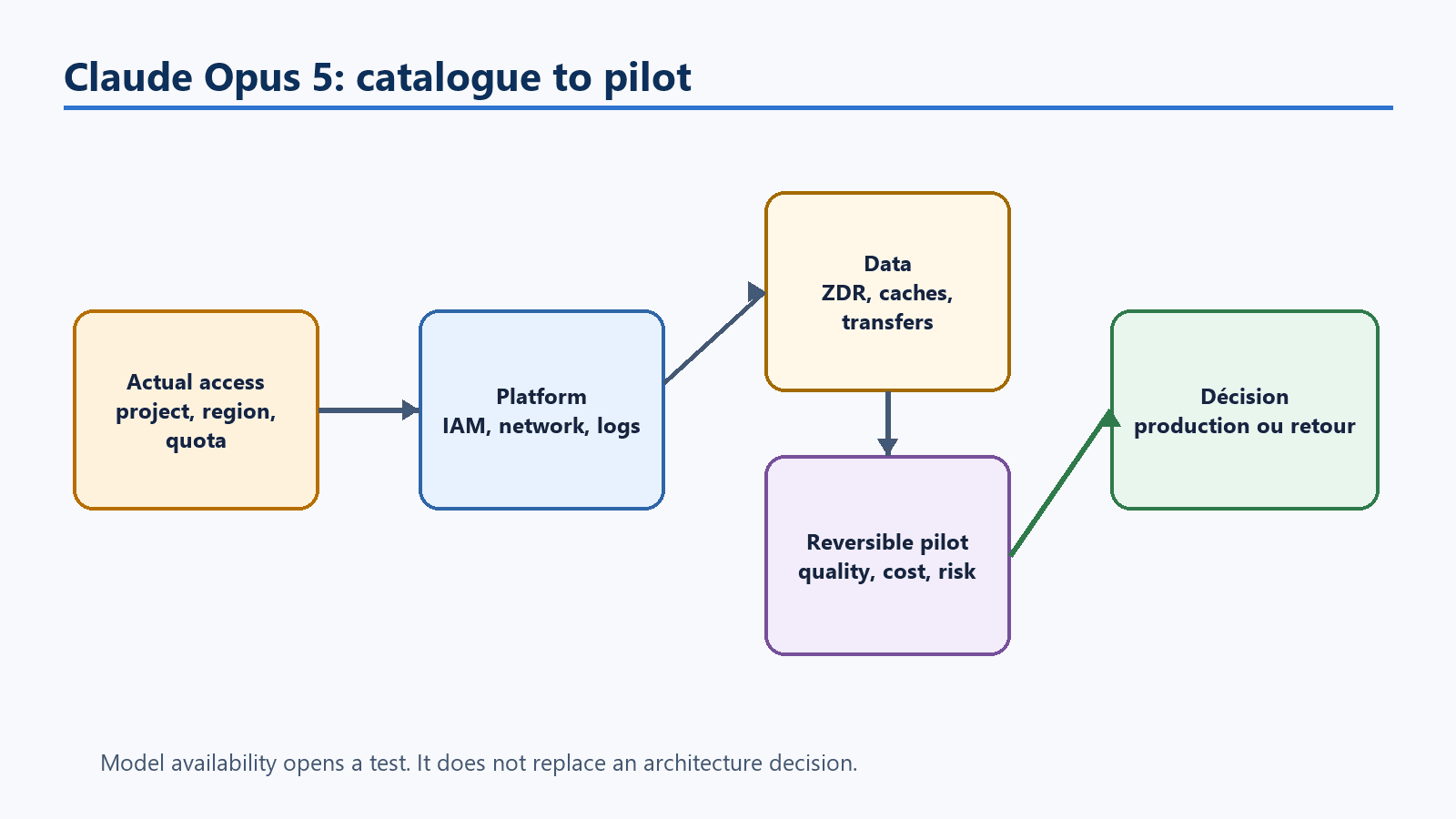
Nexxom diagram. Model availability is only the first filter. A production decision must pass platform, data-governance and business-evaluation checks.
What the announcement confirms, and what it does not
The Google Cloud What's New page dates the information to the week of July 20 to 24, 2026. Google Cloud says Claude Opus 5 is available on Agent Platform, brings improvements in selected areas and is ZDR-compatible. The post does not provide an independent protocol, a complete price table, uniform regional availability or a guarantee that every Agent Platform feature is available for every account.
Separate three levels of evidence:
| Level | What is known | What still needs checking |
|---|---|---|
| Availability | The provider announces the model on Agent Platform | project access, quota, region and commercial status |
| Technical claim | Google Cloud mentions coding, long-running agents and knowledge work | quality, latency and cost on your tasks |
| Governance | Google Cloud mentions ZDR compatibility | exact configuration, logs, caches, subprocessors and contracts |
A provider announcement is useful evidence for deciding what to test. It is not a substitute for a local evaluation or legal review.
Why the availability matters to CIOs
A model in the existing operations layer
For an enterprise already using Google Cloud, the main benefit may be operational. Google Cloud documentation describes partner models as managed, serverless APIs, with authentication and quotas handled by the platform. The Claude at scale on Google Cloud article describes IAM, VPC controls, Cloud Logging and Cloud Monitoring for Claude calls on Agent Platform.
This does not remove architecture work. Teams still need to bind application identities to the right IAM policy, define allowed regions, control outputs and decide which traces may contain sensitive data. Integration is simpler when existing controls are already understood, not merely because a model appears in a catalogue.
An option for agents and long-running tasks
Google Cloud positions Opus 5 for coding, long-running agents and knowledge work. These are broad categories. An enterprise agent must also respect permissions, time limits, call budgets and escalation rules. The Agent Platform overview describes build and deployment components, but it does not measure the quality of your workflow.
The useful test is not “can the model solve a demonstration?” It is “does the system complete our task with the same data, tools, constraints and risk thresholds as production?”
Four checks before a pilot
1. Verify actual access
Ask your Google Cloud administrator to confirm model identifier, availability status, quotas, regions and billing prerequisites. Announcements can precede detailed documentation or identical availability across environments. Keep the date and provider response in the evidence register.
2. Verify data processing
“ZDR-compatible” does not mean every form of storage disappears automatically. Google's zero-data-retention documentation explains that retention depends on enabled features, including logging, caching and grounding services. Read the terms that apply to the partner model, region and contract.
Check separately:
- prompts and outputs retained for security or support;
- prompt caches and their lifetime;
- call logs and read permissions;
- data sent to a tool or secondary agent;
- regional processing and transfers.
3. Measure quality and cost
The claim of improvement over Opus 4.8 is a provider claim. Run your own comparison with a private set, pre-defined criteria and a reference model. Measure accuracy, abstention, successful tool calls, p50 and p95 latency, tokens, errors and cost per task.
Do not compare token price alone. Total cost includes extra calls, retries, trace storage, tools, reranking, observability and human validation time. A more expensive model may be worthwhile if it reduces retries, but that hypothesis must be measured.
4. Test reversibility
The pilot should allow a return to the previous model without rewriting the workflow. Put the provider behind an interface, version prompts, retain reference outputs and plan a fallback route. For an agent, also test stopping, token expiry, action limits and recovery after failure.
Three architecture choices
| Situation | Starting decision | Why | Risk to check |
|---|---|---|---|
| Existing governed Google Cloud environment | Pilot Opus 5 on Agent Platform | IAM, network and observability may be reused | actual availability and ZDR configuration |
| Need to compare several providers | Put two models behind one interface | comparable protocol and tools | token, tool and limit differences |
| Sensitive data or strong regional needs | Start with a validated regional path | reduces processing uncertainty | check every auxiliary feature |
| Low-risk, high-volume task | Keep a lower-cost model | optimizes total cost | do not fall below quality threshold |
This is not a model leaderboard. It connects an announcement to an auditable architecture decision.
Questions to ask the provider
Before production, request written answers on model identifier and version, regions, context limits, rate limits, tool features, error behavior, retention policy, logs, subprocessors and support. Ask how model updates are announced and whether a version can be pinned.
The Claude models on Vertex AI page explains the general partner-model call pattern, but Opus 5 availability should be confirmed in Model Garden and in your contract. Review supported models and Vertex AI pricing on the pilot date because they can change.
A ten-business-day pilot
Keep a short pilot rigorous:
- choose three representative business tasks and one negative security task;
- freeze prompts, tools, versions and success criteria;
- run the reference model and Opus 5 on the same private set;
- measure quality, cost, latency, errors and human escalations;
- have difficult outputs reviewed without revealing model names;
- decide against quality and maximum-cost thresholds, not impressions.
For agents, retain each tool call and permission decision. For code, use executable tests. For document work, verify citations and source passages. For sensitive decisions, include abstention and human review.
Conclusion
The announced arrival of Claude Opus 5 on Google Cloud Agent Platform matters to enterprises that want a new model inside an already governed infrastructure. It does not turn catalogue availability into proof of performance, compliance or return on investment.
The sensible decision is to verify access, region, retention and cost, then run a reversible pilot on private tasks. If Opus 5 delivers a measurable gain without crossing risk and latency thresholds, the enterprise has an additional option. If it does not, the protocol has prevented a migration based on an announcement.
Keep the decision record with the model identifier, date, region, contract reference, test set, prompts, tool definitions and observed metrics. This makes a later model update comparable with the first pilot. It also prevents a provider catalogue from becoming an undocumented dependency in a critical workflow. A controlled fallback is part of the architecture, not evidence that the pilot failed.
The same record should state what the pilot did not measure. If it did not cover multilingual requests, long documents, tool failures or sensitive data, do not let the result imply coverage. Mark those cases as open questions and schedule them before launch. This discipline is especially important when a model is described with broad labels such as frontier, agentic or enterprise ready. Those labels describe a product position, not a guarantee for a particular process.
For procurement, add an exit condition to the pilot: the team must be able to export prompts, evaluations, logs and routing rules in a usable format. This keeps the evaluation portable if the model, region or provider terms change. It also gives security and finance teams a concrete artifact to review instead of a slide that only repeats the launch message.
Primary sources
- Google Cloud, What's new, July 24, 2026
- Google Cloud, Claude at scale on Google Cloud
- Google Cloud, Zero Data Retention
- Google Cloud, Agent Platform
- Google Cloud, Claude models
- Google Cloud, supported models
- Google Cloud, Vertex AI pricing
- Nexxom, choosing an AI model
- Nexxom, hybrid RAG
- Nexxom, AI agent processes