OpenAI Presence: what enterprise AI agent deployments change for buyers
OpenAI Presence is a managed platform for enterprise AI agents in high-volume workflows. The July 22, 2026 announcement raises a practical question: verify availability, integrations, evaluations, oversight and data handling before a pilot.
OpenAI announced OpenAI Presence on July 22, 2026. The product targets AI agents deployed in customer and internal workflows, with policies, permissions, evaluations, production monitoring and human escalation. The important question for an enterprise is not only what the model can do. It is how a team moves from a demonstration to an operated service with evidence, ownership and a viable exit path.
The short answer
OpenAI Presence is currently offered through limited general availability as a managed deployment led by OpenAI and selected integrators. It supports conversational and voice experiences, connects business systems with scoped permissions, and includes pre-launch testing plus post-launch oversight. It is not self-serve. Buyers should therefore assess integration, governance, quality evidence, total cost and reversibility before starting a pilot.
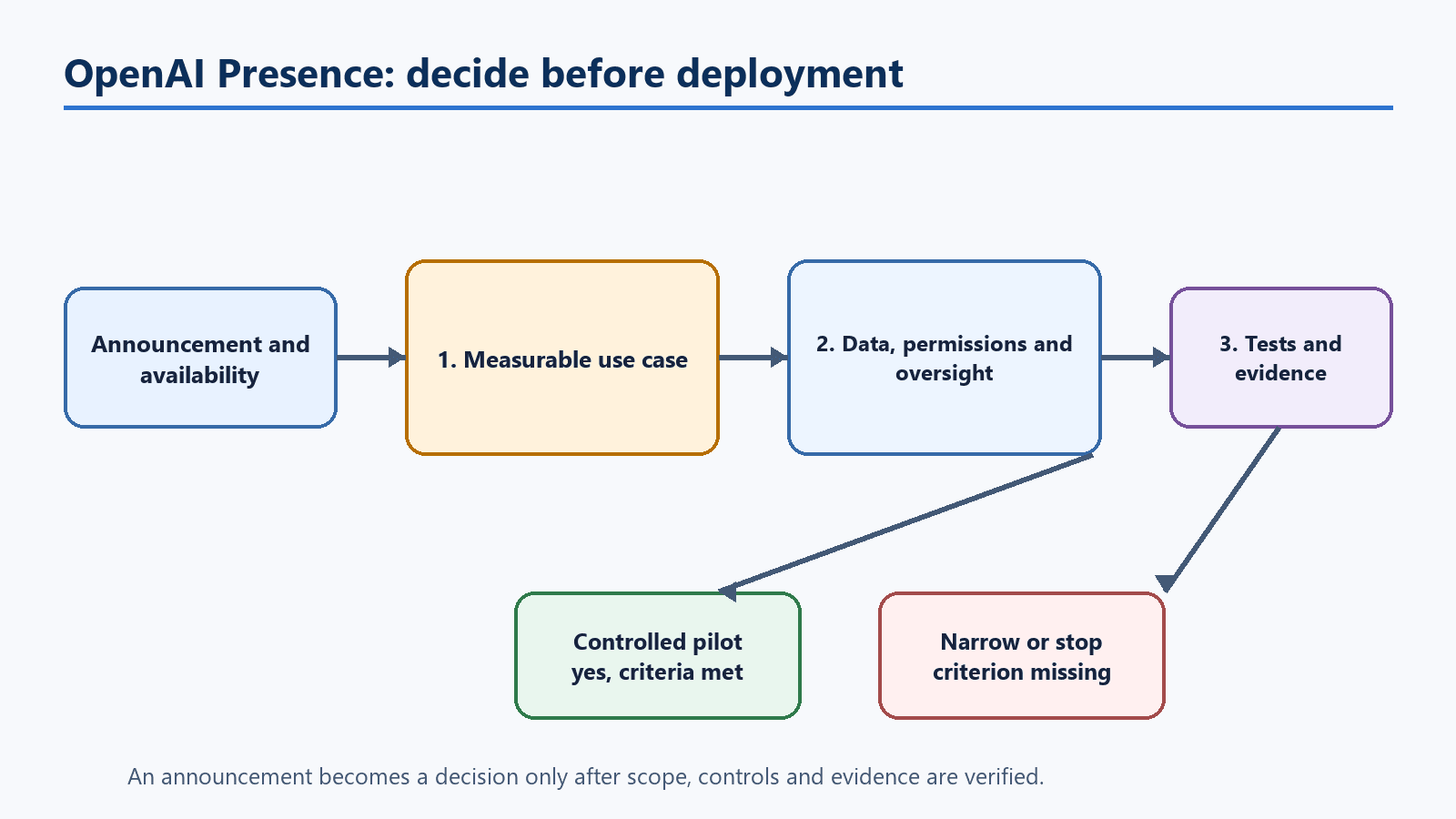
Nexxom diagram. A product announcement becomes a deployment decision only after the use case, controls, evidence and exit path are verified.
What OpenAI announced on July 22, 2026
The official announcement describes Presence as a product for deploying agents that can answer questions, resolve issues, use company systems, take approved actions and hand an interaction to a person. OpenAI says each deployment starts with a specific job, such as billing support, insurance claims or internal IT service. Exact capabilities and integrations are established during technical scoping.
OpenAI also describes a production loop: connect the required knowledge and systems, define policies, test common requests and edge cases, roll out in a controlled way, then review sessions, escalations and quality signals. The OpenAI launch announcement presents this loop as part of the product rather than a task left entirely to the customer team.
The OpenAI Help Center overview, updated on August 10, 2026, adds buyer-relevant limits. Presence is a managed platform, not a self-serve product. Access depends on workflow fit, implementation readiness and delivery capacity. Model details, channels, capacity, data handling, pricing and service commitments are defined for each deployment.
OpenAI also publishes results from its own operations: its English-language phone support channel reportedly resolves 75% of inbound issues without human assistance, while an improvement loop reportedly reduced human handoffs by 15 percentage points in ten days. These are vendor-reported results, not an independent benchmark. They do not predict performance for a different customer workflow.
What the launch changes for an enterprise decision maker
Presence moves the question from “which model should we call?” to “which operated service can we govern?” With a conventional API purchase, the enterprise often designs orchestration, controls, evaluations and oversight. With a Presence deployment, some of those responsibilities are offered with the provider, but the enterprise still owns its process, data, approval rules and obligations.
| Buying question | What OpenAI describes | What the enterprise must verify |
|---|---|---|
| Availability | Limited general availability, managed deployment, no self-serve access | Eligibility, delivery capacity, timeline, integrator dependency and exit terms |
| Channels | Voice and chat during limited availability | Languages, telephony, authentication, handoff, recording and service continuity |
| Actions | Information retrieval, system updates and approved actions with scoped permissions | Tool catalogue, scopes, read-write separation, approval and cancellation |
| Quality | Simulations, evaluations, edge cases, sessions and escalation monitoring | Representative test set, thresholds, false positives, false negatives and evaluation ownership |
| Data | Handling defined for each deployment | Location, retention, masking, subprocessors, operator access, export and deletion |
| Change | Suggested improvements and controlled rollout | Change approval, versioning, rollback, audit and ownership after modification |
This grid prevents a platform promise from being mistaken for evidence that fits your context. It complements the Nexxom method for selecting an agentic process, which helps determine whether a workflow deserves an agent at all.
Five decisions to make before a pilot
1. Choose measurable work
A good first workflow is frequent, repetitive, documented and reversible. It has a clear success definition: time to resolution, first-contact resolution, escalation rate, procedure compliance or manual work removed. Avoid a pilot whose success criterion is simply that “the answers sound natural.”
2. Define required systems and data
List the sources consulted, systems changed, personal data, secrets, tenants and external destinations. The OpenAI Help Center states that data handling, logging, masking, retention and location are deployment-specific. Ask for the architecture and contract for your case, rather than relying on a generic platform answer.
3. Set action boundaries
Classify each action as read, propose, reversible write, sensitive write or irreversible action. An agent can prepare a refund without executing it. A person can approve a contract change. The business system, not only the prompt, must enforce this separation. Our article on MCP and agent security explains the same least-privilege and logging logic.
4. Require evaluation before and after launch
The test set should represent ordinary requests, ambiguity, edge cases, supported languages, bypass attempts and failures in connected systems. Measure outcome accuracy, policy adherence, tool use, escalation rate, resolution time and incidents separately. OpenAI's published results can provide context, but they are not a contractual threshold for your operation.
5. Negotiate the exit before the entry
Ask how to export logs, evaluations, configurations, prompts, policies, knowledge data and correlation identifiers. Confirm reversibility to another orchestration layer or a human process. A pilot without a rollback plan turns an operating dependency into a continuity risk.
How to read limited general availability
Limited general availability is neither a normal waiting list nor proof of universal maturity. OpenAI says access depends on workflow fit, implementation readiness and delivery capacity. Deployments are led by OpenAI, a selected integrator or both. The enterprise should clarify who owns the integration code, tests, policy changes, monitoring and incidents.
This model may reduce the number of components a team must assemble for a high-volume workflow. It also creates governance cost: part of the operation depends on a managed service, a deployment relationship and configuration decisions that are not equivalent to a simple API call.
Presence does not remove enterprise responsibility
A provider can supply guardrails, simulations and an escalation process. It cannot decide which data your team may access, which risk your committee accepts, what evidence an auditor expects or which procedure applies to a specific customer.
The NIST AI Risk Management Framework recommends managing risks throughout the lifecycle, from design to operation. In the European Union, applicable requirements depend on the system and its use. The European regulation highlights the importance of human oversight for high-risk systems. A Presence announcement is therefore not a compliance attestation. Qualify the use case, document controls and obtain legal and security review where appropriate.
A quick decision by scenario
| Situation | Provisional decision | First evidence to request |
|---|---|---|
| Frequent support, stable procedure, reversible actions | Pilot may be appropriate if metrics and escalation are defined | Test set, escalation threshold and rollback plan |
| High-impact process or highly sensitive data | Limited pilot with security and legal review | Data, access, retention, oversight and audit matrix |
| Highly variable or poorly documented workflow | Do not start with Presence | Process map and success criteria |
| Low-volume, one-off need | Compare with simpler automation | Total cost, integration effort and actual frequency |
Questions to ask before signing
- What exactly is available for our region, languages and channels?
- Who operates each component and who responds to an incident?
- Which systems, data and actions can be connected, and with which scopes?
- How is human approval bound to the exact action executed?
- Which logs are produced, redacted, exportable and retained for how long?
- Which tests are supplied, which thresholds trigger escalation and who owns the results?
- How do we validate, version, deploy and roll back a policy or model change?
- How do we recover configurations and evidence if the service is stopped?
If the answers remain generic, the project is not ready for a high-impact pilot.
Frequently asked questions
Is OpenAI Presence a self-serve product?
No. OpenAI describes it as a managed offer in limited general availability. Access and scope depend on the workflow, enterprise readiness and delivery capacity.
Does Presence replace an AI engineering team?
No. It may package operated components and deployment support, but the enterprise still defines the process, data, permissions, thresholds, evidence, continuity and ownership.
Can OpenAI's published results be transferred to my business?
Not without a comparable protocol. The reported rates concern OpenAI operations and are presented by the vendor. They should inspire measurement questions, not become a performance promise.
Conclusion
OpenAI Presence illustrates a market shift: enterprises increasingly buy an operating and deployment lifecycle for agents, not just a model. The sensible decision is not to adopt or reject the offer from the announcement alone. Verify workflow fit, action boundaries, data, evaluations, oversight, contract terms and exit options. A pilot may make sense for a frequent, documented and reversible workflow. An unclear or irreversible process needs narrower scope and stronger governance first.
Primary sources verified on August 11, 2026
- OpenAI, Introducing OpenAI Presence, July 22, 2026
- OpenAI Help Center, OpenAI Presence, updated August 10, 2026
- OpenAI, A practical guide to building agents
- NIST, AI Risk Management Framework
- EUR-Lex, Regulation 2024/1689, human oversight and high-risk systems
Availability, capacity, models, channels, pricing and data-handling details may change. Verify the technical and contractual terms of your deployment before making a decision.